Part of the country series of articles.
TRAVEL ADVISORY: EXERCISE CAUTIONThe Commonwealth advises travellers to exercise caution in this country. Some areas or circumstances may carry elevated risk. Travellers should monitor local conditions and follow the guidance of local authorities.
| Fiji Protectorate | |
|---|---|
| British Protectorate | |
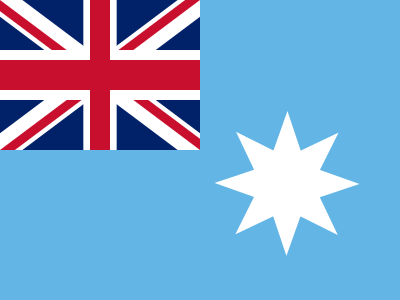 |
|
| Capital | Suva |
| Languages | English, Fijian, Hindi |
| Population | 980,000 |
| Suzerain | United Kingdom |
Fiji is an archipelago of some 330 islands in the South Pacific, of which approximately a hundred are inhabited and a dozen are commercially significant. Britain has administered the protectorate since 1874, when the paramount chiefs ceded sovereignty; independence negotiations have proceeded intermittently but have not concluded, largely because the constitutional question of land rights and political representation between the two main communities has not been resolved to either community’s satisfaction. Suva, the capital, sits on the wet eastern coast of Viti Levu, the main island, and is a substantial tropical city with covered markets, colonial administrative buildings and a working port.
The sugar cane fields covering much of the western plains of Viti Levu are farmed predominantly by Indo-Fijian communities, descendants of workers brought to the islands under the British indentured labour system in the nineteenth century. Indigenous Fijians hold land ownership rights under the protectorate’s constitutional arrangements and regard those rights as non-negotiable; Indo-Fijians produce the majority of the country’s food and conduct much of its commerce but hold no land and exercise limited political authority. British administration has managed this tension through power-sharing arrangements but remain unresolved.
Tourism and sugar are the two primary economic pillars. The resort islands of the Mamanuca and Yasawa groups attract visitors primarily from Australia and New Zealand, which are the dominant economic partners and the largest sources of tourists. The interior of Viti Levu and the larger islands support subsistence and export agriculture.