Part of the country series of articles.
TRAVEL ADVISORY: NORMAL PRECAUTIONSThe Commonwealth advises travellers to exercise normal precautions when travelling in this country. Travellers should familiarise themselves with local laws and customs and consular availability.
| United Kingdom of Great Britain | |
|---|---|
| Constitutional Parliamentary Monarchy | |
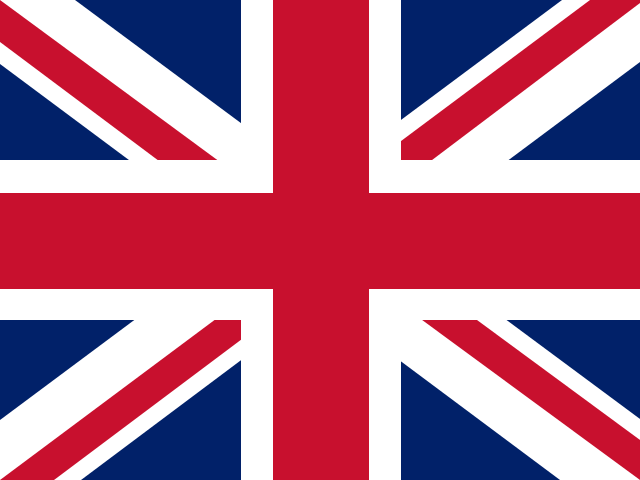 |
|
| Capital | London |
| Languages | English, Welsh, Scottish Gaelic |
| Population | 70,500,000 |
The United Kingdom of Great Britain (U.K.) is an island nation off the northwestern coast of Europe, comprising England, Scotland and Wales, with a population of about 70 million people. Northern Ireland, a former constituent country of the union, transferred to the Republic of Ireland under a negotiated constitutional settlement in 1989. The U.K. is a constitutional parliamentary monarchy, a nuclear power, and a permanent member of the United Nations Security Council. It was once a great empire that controlled and subjugated Many parts of the world. The economy has retained a more substantial industrial base than many comparable European countries, and is anchored by aerospace, pharmaceuticals, engineering and arms manufacture, alongside the financial services concentrated in the City of London.
Britain’s formal empire has contracted considerably since the Second World War, but the process has mostly been well-managed compared to its continental neighbours. The Caribbean and Atlantic territories acceded to the Commonwealth through negotiated independence in the 1960s and 1970s, and most remaining dependencies were resolved through bilateral agreements by the 2040s. Several territories remain under direct British protection, among them the Trucial Coast and Kuwait in the Persian Gulf and a number of Pacific island groups including Fiji and Tuvalu. Many of these former colonies retain strong ties to the country through the Commonwealth of Nations (distinct from the Atlantic Commonwealth), which serves purposes of trade and diplomacy.
Britain is a member of NATO and the European Economic Community. Its relationship with the United States is the central feature of British foreign policy. Relations with Washington are warm but regularly strained, most often over trade, colonial questions and British arms sales to Asia and Africa. Britain competes with America for cultural presence in the countries that were once part of the empire through its well-run and well-funded news and entertainment industries.