Part of the country series of articles.
TRAVEL ADVISORY: EXERCISE CAUTIONPARSTATE advises travellers to exercise caution in the Maghreb Federation. Conditions vary significantly between the prosperous coastal cities and the southern desert interior, where federal authority is inconsistent and banditry remains a concern on some routes.
| Maghreb Federation | |
|---|---|
| Federal Republic | |
 |
|
| Capital | Tunis |
| Languages | Arabic, Tamazight, French, Spanish, and many regional languages |
| Population | 68,400,000 |
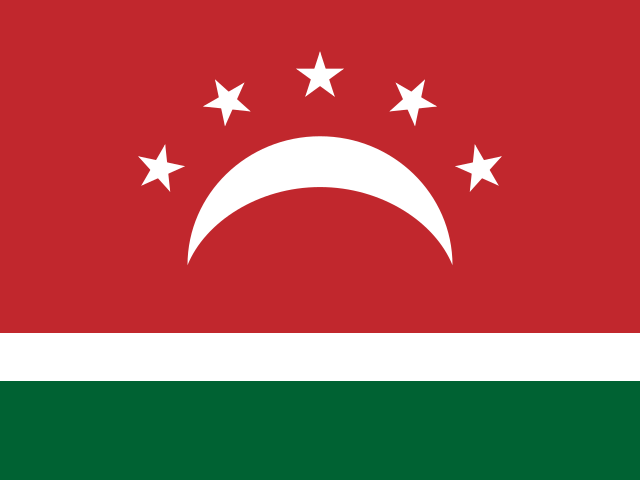
The Maghreb Federation is a federal republic occupying the North African littoral from the northern border of Mali to the Tunisian border with Libya, extending south into the northern Sahara. It encompasses considerable internal variety: Atlantic coastal cities with Andalusian architectural influence, Berber communities in the Atlas mountain ranges, Arab towns along the Mediterranean coast, Jewish quarters of considerable antiquity, and a Saharan fringe administered with limited federal reach. French and Spanish colonial influence persists in law, architecture and urban educated culture, overlaid on older Moorish and Amazigh elements that the federation has formally incorporated into its national cultural programme.
Libya separated from the federation approximately half a century ago, a division that remains a source of diplomatic bitterness in Tunis. The federation is governed by a federal parliament in Tunis, with regional governments exercising substantial autonomy within the federal structure. The country has experienced periods of military government and the current civilian administration has been in place long enough to have developed institutional continuity. Trade flows primarily to Vekllei, France and across the Mediterranean. The major cities – Tunis, Casablanca, Fez, Oran – are important commercial and cultural centres in the broader Mediterranean and African context.