
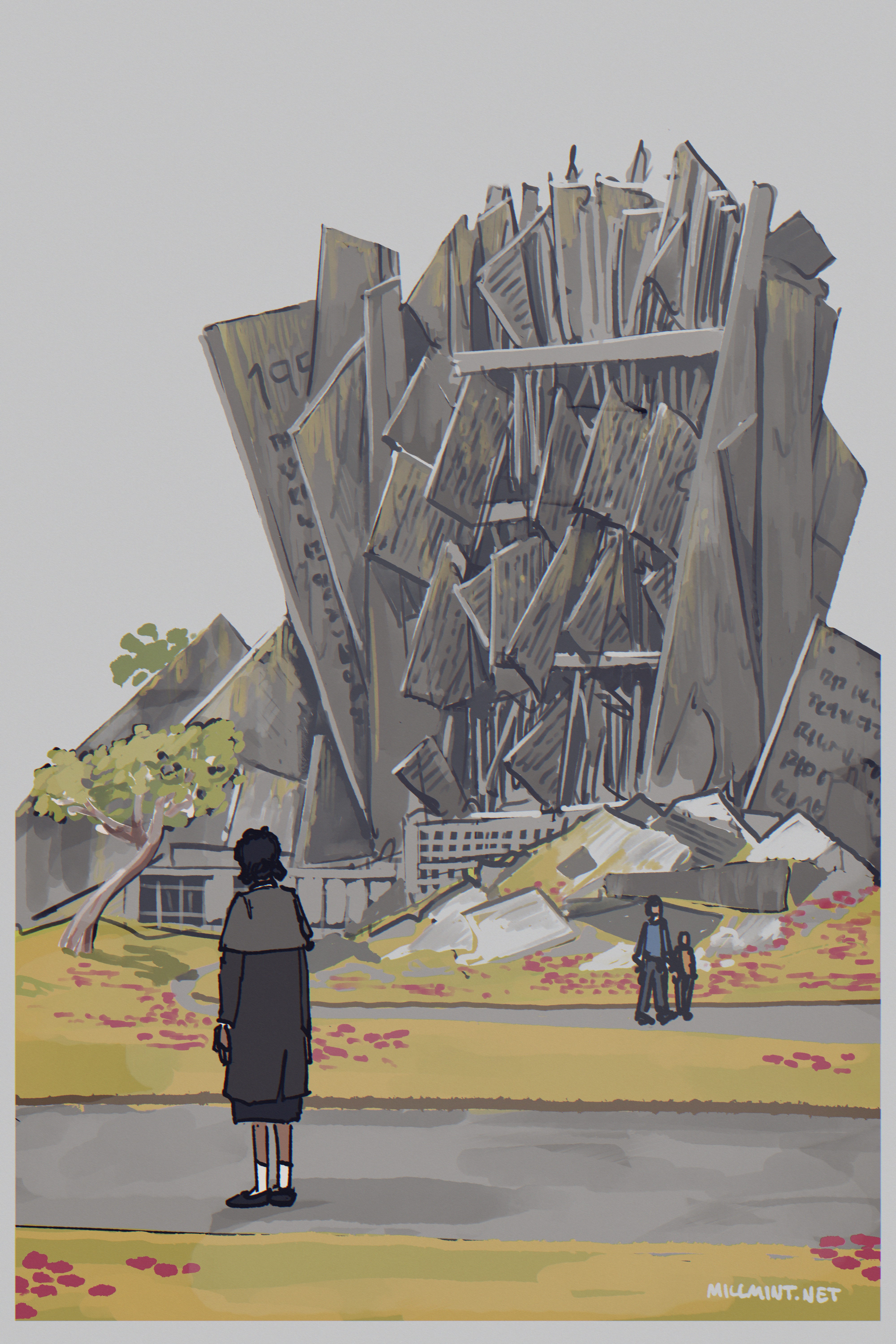
“The Catastrophe” is a sculpture in northern Oslola. It is a monument to the Atomic War; a picture of creation; a rejection of teleology; a claim of the dead; and a reflection on the sublimation of history. It is made of concrete, lead, iron rebar and glass.
The Atomic War occurred in 1950 and killed half a million people in what we know as Oslola. The huge sculpture is littered with radioactive glass, and its decaying and broken shelves recall the scorched walls and endless ruins of the bomb sites.
It is also a picture of Lurianic creation, a sculpture of a world not fallen from grace but of withdrawn divinity. In an atomic metaphor, shards tumble from the monument like the broken vessels under the return of God’s light.
It appears as wreckage stacked high and piling higher still; blown by the storm called progress, unable to be redeemed or restored. The shelves carry a record of the victims of history as a single catastrophe, wrecked concrete pages inscribed with the theology of advancement.
Lead is the unredeemed, base metal. Lead scraps tumble from the shelves here, their promise as the catalyst of alchemy forsaken, repurposed as a crude shield from radiation. The huge shelves carry the unrealised dreams of the dead, tumbling out. What is our obligation to them?
The shelves and scripture reflect the classificatory and rationalist nature of modernity, and the violent artistic capture of the dead as an object of history, organised and vulgarly sublimated into the sculpture, replacing them. What is our obligation to history?
Explanation
The caption is making reference to Walter Benjamin, specifically his Theses on the Philosophy of History which took the form of short paragraphs shortly before his death in 1940.
The Theses is a reaction to the time he lived in, but has relevance today. In it, he argues that history is not a story of progress. The dominant view (including in orthodox marxism) is that history is basically marching forward towards a better future. Benjamin instead casts history as a single catastrophe through the metaphor of an angel, facing backwards towards the past, watching in horror as wreckage is piled higher and higher and the angel is blown backwards, unable to repair the wreckage, forced towards the future by the “storm of progress.” Here, “progress” is recast as a disaster, not in a luddite sense but as a form of historical complacency.
Benjamin also makes reference to Jewish messianism, which is the idea that redemption does not lie at the end of the long march of progress, but something that could erupt at any moment. His view is that every generation has a duty to the dead and the victims of the past because they have a “weak claim” on the present, precisely because the meaning of our present is bound up with it.
This is where the sculpture uses the metaphor of Lurianic creation, which is a Jewish cosmology that describes a contraction and then return of divine light which broke the vessels of creation, shattering them. In this belief, tikkun or repair of these holy sparks is our purpose (like Benjamin’s Angel of History, with the wreckage).
The final caption paragraph is a musing on Adorno’s non-identical, which is a criticism of Enlightenment’s capture of particulars into wider concepts as a form of domination. When you capture things in concepts, you leave something out, which remains unresolved – “workers,” “consumers,” etc. The statue is mourning the “sublimation” of countless sufferings, real people and real things, into itself as self-criticism.
The design’s most direct reference is Kiefer’s Sternenfall which was at MONA when I worked there as a teenager. It depicted tzimtzum, or the withdrawing of light to make room for creation. A thin ray of light was then cast out into this void, pouring into metaphorical vessels which shattered under its pressure
Kiefer himself is essentially a Benjaminian artist, born in 1945 Germany. Sternenfall has little scraps of paper amidst the heavy shards of lead and glass with numbers inscribed on them. The most direct image of them is of course of the Holocaust – people numbered and filed – but I think the sculpture illustrates well Adorno’s criticism of conceptual capture and the teleology of so-called secular philosophy; this hulking bookshelf of tomes (knowledge, bureaucracy, records) shattered and collapsing in the same fashion as the vessels