Part of the country series of articles.
TRAVEL ADVISORY: NORMAL PRECAUTIONSThe Commonwealth advises travellers to exercise normal precautions when travelling in this country. Travellers should familiarise themselves with local laws and customs and consular availability.
| Federation of Micronesia | |
|---|---|
| Federal Republic | |
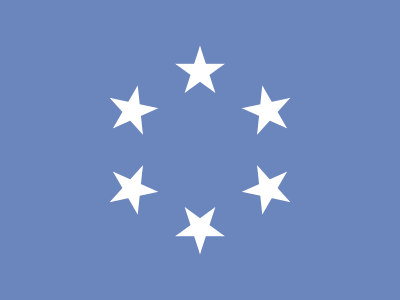 |
|
| Capital | Palikir |
| Languages | English, Marshallese, Palauan, Chuukese, Pohnpeian, Kosraean, Yapese |
| Population | 181,000 |
The Federation of Micronesia is a federal republic spanning the western and central Pacific from the Palauan archipelago in the west to the Marshall Islands atolls in the east — an oceanic territory of roughly five million square kilometres containing several hundred islands with a combined land area of under two thousand square kilometres. Palikir, a government settlement constructed on Pohnpei, serves as the federal capital. The federation was consolidated from the United Nations Trust Territory of the Pacific Islands, administered by the United States after the Second World War, when the constituent island groups chose a common federal structure rather than separate independence during the trust territory’s formal conclusion in the 1970s.
The federation’s constituent states are culturally and linguistically distinct. The western group – Yap, Chuuk, Pohnpei and Kosrae – and the eastern Marshallese and Palauan states are bound by shared administrative history and by a Compact of Free Association with the United States that provides the majority of the federal budget through annual transfers. Tuna licence revenue, generated from one of the largest exclusive economic zones in the Pacific, is the principal local source of income.
At the western edge of the federation, the Palauan reef system is among the most biologically diverse in the Pacific. The marine sanctuary established in Palauan waters draws international diving visitors and supports a tourism sector financed through conservation fees rather than commercial fishing licences. Chuuk Lagoon holds the submerged hulls of a Japanese fleet sunk in 1944, the wrecks now colonised by coral and marine life, drawing a separate category of visitor to the central states. In Yap, traditional stone money – large circular limestone discs whose value is social and historical rather than monetary – remains in active use, and the navigational traditions of the outer islands have mostly survived American administration intact.