Part of the country series of articles.
TRAVEL ADVISORY: NORMAL PRECAUTIONSThe Commonwealth advises travellers to exercise normal precautions when travelling in this country. Travellers should familiarise themselves with local laws and customs and consular availability.
| Republic of Mapuraque | |
|---|---|
| Republic | |
 |
|
| Capital | Bariloche |
| Languages | Spanish, Mapudungun |
| Population | 1,500,000 |
The Republic of Mapuraque is a small republic in the southern Andes, occupying the lake district along the spine of the cordillera from Llanquihue in the north to Nahuel Huapi in the east. The Mapuche held this territory against Spanish colonisation for over three centuries and against Chilean and Argentine military campaigns for most of the nineteenth century. The Chilean Occupation of Araucania nearly reached the lake district, but was halted by the Chilean Civil War of 1891 before it could be completed.
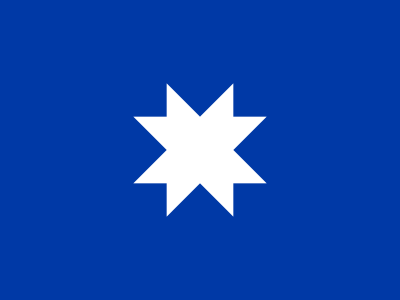
A 1902 British boundary arbitration between Chile and Argentina recognised a Mapuche territorial zone in the lake district as a condition of settling the broader dispute. Often described as an “indigenous republic” rare for the South American continent, Mapudungun is Maparaque’s co-official language, and the flag incorporates Mapuche iconography. Despite this, a large number of people with Spanish ancestry reside there.
Bariloche, the capital, is a lakeside city of largely nineteenth-century European settler architecture, surrounded by snow-capped peaks and glacial lakes. The economy is based on timber, trout farming, pastoral agriculture on the eastern slopes and tourism, which has grown substantially in recent years. Visitors come predominantly from Chile and Argentina. The endless feud between its neighbours has benefited the small republic, which received formal recognition in the 1930s.